.png)
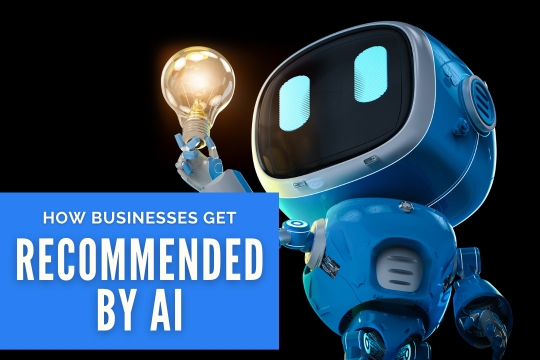
The way consumers search for information is changing. Today, your customers do not just Google. They ask chatbots for direct answers instead. Tools like ChatGPT, Gemini, Perplexity, and Copilot deliver these immediate solutions. This shift reshapes how people discover local businesses and transforms online visibility.
When someone asks AI for a recommendation, they don't get ten links to sort through. They get one answer, maybe two. That response comes from data the system already trusts. Your business either shows up in that final output or it stays invisible.

How do businesses get recommended by AI search tools? Earning a spot in those AI answers starts with being clear about what you do. These platforms need precise details to work with. They have to know your services and who you serve before they can point anyone your way. Without that, the algorithm moves on.
Strong AI optimization makes your company easy for algorithms to verify. This creates the foundation modern search platforms demand. Chatbots drive customer decisions now. Companies that adapt first gain a real competitive advantage.
AI search doesn't work like traditional platforms. Google gives you a long list of links to sort through yourself. Chatbots skip that step and deliver one direct answer. That answer pulls from your digital content and connects it to what the customer needs.
There's a reason direct recommendations convert better than search lists. When ChatGPT recommends a specific business, buyers don't second-guess it. They trust it the way they would trust advice from a friend. It feels personal, not like advertising. That difference moves people from browsing to buying a lot faster.
There's a catch, though. AI systems only recommend businesses they trust. Vague content breaks that trust fast. If your business details don't match across platforms, the algorithm can't confirm what you actually do. When that happens, it skips you and moves on.
AI tools don't rely on just one source to learn about your business. They cross-reference multiple sources before they recommend anyone. Your website, local listings, directories, customer reviews, and social profiles all factor in. The more complete and consistent those sources are, the better your chances of showing up.
Not every business makes it into AI results. These are the signals that determine who does:
Without them, chatbots have no reason to mention your name. The businesses that check every box on that list are the ones AI recommends first. Start with one signal and build from there.
Schema markup is basically how you talk to AI in its own language. These tags tell the system your hours, services, and location without making it guess. Get this right, and the algorithm has everything it needs.
Most modern website builders include simple tools to add this code. You do not need to hire a developer or learn complex technical skills. The setup process takes very little time. That small effort delivers proven results.
Clean schema speeds up how artificial intelligence processes your pages. Organized data makes these systems confident enough to recommend your brand. This earned trust puts your business in front of more customers. Adding this simple code remains one of the best ways to boost your digital visibility.

AI tools use natural language processing to read your website the way a person would. They look at language, structure, and context together, not just keywords. Vague descriptions and confusing marketing jargon make that job harder. Clear writing helps AI connect your content to the right customer questions.
Your website should explain your specific services, locations, audience, and value. A human visitor should never have to guess what your business does. AI search tools need that same clarity before they can recommend your brand.
Conversational content gives you a real advantage here. Customers ask questions in everyday language rather than short keywords. They may ask, 'Who offers the best roof repair near me?' Your website should answer that exact question.
Answering those questions gives AI exactly what it needs to work with. Direct answers put your business in the running for recommendations.
Keywords still matter for search success, but exact terms alone don't tell the whole story. AI tools look beyond simple matches and examine context, intent, and usefulness. A conversational content strategy works better here than keyword stuffing ever will.
Small businesses should create content that addresses real customer questions. Helpful FAQ sections, blog posts, and detailed service pages can guide your audience. This information also helps position your website as a reliable industry source.
For example, a local plumber might publish project timelines and pricing details. A roofer can explain common maintenance problems or service area coverage. That kind of content helps customers make decisions. It also gives AI tools a better context when matching your business to a search.

Chatbots don't just look at your website. They pull from directories, social platforms, reviews, and articles all across the web. That means your NAP data, name, address, and phone number need to match everywhere. One mismatch and the system starts to doubt you.
Reddit mentions, YouTube citations, and forums all feed into brand visibility in LLMs. Trusted industry sites carry even more weight. They tell the system you exist beyond your own pages. Building that kind of outside presence takes time, but it pays off. Customer feedback and reviews give AI real context about what it's like to do business with you. That's how authority gets built.
Focus your energy on these five things:
Most consumer AI searches have local intent. Buyers are looking for someone nearby, not just anyone who offers the service. Local optimization puts you in front of those searches. Getting specific about where you operate is what connects you to the right customers.
AI recommendation engines heavily weigh local signals. A business with strong local content will always outrank one with a generic web presence. Consistent location data widens that gap. The more specific you are about your service areas, the easier it is for AI to match you to nearby buyers. Think of your local content as a map that guides AI straight to your front door.
A complete Google Business Profile is your starting point. From there, focus on these specific local signals:

AI visibility builds on traditional search engine optimization (SEO) practices. It doesn't replace them. Search engines still need to crawl and index your site before chatbots can find you. Most business owners skip this step and wonder why they aren't showing up. That technical groundwork is non-negotiable.
This approach now has its own name. Modern marketers call it Answer Engine Optimization (AEO), or Generative Experience Optimization (GEO). Both come down to the same idea: make your content easy for AI to find, read, and trust. A well-structured page and a clean heading hierarchy help AI read your site more effectively.
If your site isn't there yet, standard SEO practices for search rankings are still the right starting point. Fast load times affect how AI tools read your pages. So does mobile optimization and a clean site structure. Nail those fundamentals before anything else. Schema markup and frequently asked questions (FAQ) sections work better on a solid technical foundation. Adding those elements to a weak site structure rarely delivers the results you want.
AI visibility doesn't happen overnight. It takes consistent effort across multiple areas. Show up on every platform and answer your customers' questions. Give these systems something solid to work with, and they will reward you for it.
A conversational content strategy helps more than most business owners expect. Writing the way your customers actually talk makes your content easier for AI to extract and use. Structured data for AI discovery adds another layer. Together, they give these systems two clear ways to find and trust your business.
If you are wondering how businesses get recommended by AI search tools, the short answer is trust. AI tools need consistent business details, helpful content, local signals, and outside authority before they recommend your company.
Focus on these actions:

Your competitors are already figuring this out. Companies that wait risk losing ground that's hard to recover. The businesses showing up in AI results right now started building trust early. Every day without a strategy is a day your competition pulls further ahead.
AI didn't kill traditional search. It just changed where the customer lands. That landing spot is a short list of businesses that did the work. The businesses that act now are the ones that will own those results.
The question of how businesses get recommended by AI search tools comes down to one thing: trust. Build that, and the visibility follows. E-Marketing Associates helps local companies show up where it matters. We build strong profiles that prepare your brand for what's coming. Contact our team to optimize for AI search results and dominate the modern search landscape.








.avif)