.png)
This is Part 1 of our 3-part series on how small businesses can use AI to improve operations. In this first article, we’ll introduce what AI is, why it matters for SMBs, and how to get started by identifying the right use cases, setting clear goals, and preparing your team for AI adoption.
Two obstacles prevent many brands from embracing AI for small business operations. The first one is pure functionality. Scattered spreadsheets, manual records, and inconsistent record-keeping may make AI integration seem impossible. If you are still relying on sticky notes to keep the calendar current, it does appear challenging. The second obstacle is cost. Business owners wonder which problems AI can solve for their unique operations. Moreover, there is a concern about hidden costs such as setup, maintenance, or training. Let's talk about it.
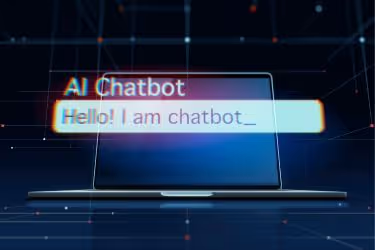
These automated tools are excellent options for easing into the use of AI for small business operations. Because chatbots utilize machine learning, they are well-suited for handling typical inquiries and responding to frequently asked questions (FAQs). Examples include information about return policies, reservation booking, and basic business details.
You can use a chatbot on your website and on social media platforms. Besides inbox management and automated scheduling, AI can serve as a tool for capturing and qualifying leads by asking specific questions, collecting contact details, and routing leads to the person responsible for handling them.
Select a model you want to use and begin with the most frequently asked questions. Use the top customer queries for this process. Next, integrate the technology with your calendar to enable online scheduling, an e-commerce platform to manage orders, and customer relationship management (CRM) software to assist with lead generation.
It is easy to overthink the automation of this type of task.

Small businesses seeking a fast return on investment (ROI) after integrating AI will do well by using it to streamline their workflows. Here, AI for small business operations refers to automating manual tasks to increase efficiency and reduce errors.
In this context, AI can assist with administrative tasks, such as drafting emails, organizing notes, and autofilling documents. For the person in charge of scheduling, AI tools can help send reminders, coordinate across multiple calendars, and reschedule appointments without requiring a customer to speak with a staff member.
If you notice that staff members are struggling to keep up with customer inquiries, consider using AI to streamline workflows for order updates, FAQs, CRM updates, follow-up message generation, and lead qualification. As you can see, simplifying workflows frees up employees by reducing the time they spend on paperwork, callbacks, and data entry.
So far, we have focused on AI functionality. But which tools are actually available for automating customer service emails, using an AI assistant for daily operations, or relying on AI for small business marketing? If you are ready to dip your toe in, these are the platforms to consider:
It is interesting to note that you may already be using some AI-powered tools without actually realizing it. For example, the Grammarly platform does more than check grammar and spelling. It helps you refine your writing, whether you're drafting emails or lengthy documents. HubSpot has AI functionality for email personalization, customer response automation, and lead nurturing.

You are thinking of using AI for inventory tracking, predictive analytics, and data cleanup. Great! But what about using the technology for content generation and customer interactions? Here, things get complicated. Interestingly, it has nothing to do with legalities or policy creation. Instead, ethics must focus on the transparent use of AI so that the technology helps your brand build trust. Your customer demographic's concerns over (and acceptance of) AI must drive AI implementation.
Let's examine ethical AI from a practical standpoint.

Artificial intelligence is as biased, uninformed, and plain wrong as the people who make it, train it, and use it. For example, when you train the technology to use machine learning, a personal bias can easily sneak in. Ask yourself if the technology's hiring recommendations, lead scoring, or service call prioritization would disadvantage a certain demographic. Additionally, AI can be incorrect, but with its built-in confidence, it may not be apparent. It is up to you or an employee you appoint to fact-check the output.
By the way, ethics and limitations do not just affect customers. They also affect employees. Work with your employees to see AI as an assistive productivity tool but not a replacement for (human) common sense and greater problem-solving skills.
Did you know that AI is already in use to help customers choose businesses? If your website is not suitable for AI's evaluation tools, you may be missing out on business. You know your business, but we know how to optimize small business presence for AI platforms. Schedule a call today!
-----------------------
AI for SMB Operations: A 3-Part Series
✅ Part 1: Getting Started with AI for Small Businesses








.avif)