.png)
Welcome to Part 2 of our 3-part series on AI for small business operations. In Part 1, we shared practical ways that small businesses can get started with AI. In this article, we’ll explore practical AI applications, including task automation, AI-powered sales and marketing, and data-driven decision-making using a crawl-walk-run approach.
Artificial intelligence (AI) could be instrumental in helping small and mid-sized businesses (SMB) operate more efficiently, profitably, and competitively. Unfortunately, small business automation can sound expensive and, in some cases, does not offer practical AI applications that small businesses can use right away. Let's see if we can do better.

Generative AI tools are software applications that help you create new content for your business. Examples include website articles, customer emails, illustrations or fabrication processes, avatars, podcasts, and signage concepts to discuss with your local sign shop. These AI applications for small businesses (and also mid-sized companies) speed up content creation, reduce marketing costs, personalize messages, and help you put together your next ad campaign without a large back-office team.
Examples of apps to consider include ChatGPT for written content, Midjourney for commercial visuals, and ElevenLabs for AI-generated voice products. Keep in mind that while generative AI tools excel at creating innovative content, they still need human review before being used on a website, blog, podcast, or customer handout. Because of the need for human oversight, many small businesses still choose to rely on third parties rather than AI tools for digital marketing.
If AI-driven content creation for small business owners is not what you are looking for, consider the marketing angle. For example, HubSpot's CRM (customer relationship management) platform is an excellent tool for sales and contact management, basic email automation, and reporting. Zoho CRM focuses more closely on sales automation and predictive lead scoring. These platforms offer tiered plans that let you start with a low upfront cost and gradually increase your use as the business grows. If you want to focus on money management, predict cash flow, and categorize expenses, QuickBooks with AI functionality is an attractive solution.
What do marketing automation software, AI for customer service, and automated email marketing have in common?

One of the biggest mistakes small business owners make when considering business process optimization is chasing the wow factor. Flashy technology is not necessary when evaluating affordable AI platforms for small businesses. Instead, focus on productivity software that:
A great example is machine learning in small-business operations, which uses historical data to make future predictions. The technology evaluates customer behavior during website visits, predicts outcomes, recommends actions, and automates decision-making based on real-time data. Use the application to score leads, optimize ads, predict churn, and personalize emails. (HubSpot and Zoho are excellent tools for these tasks.)
Inventory management is another time-consuming task that AI can take off your hands. You want to avoid buying more stock than you need and running out of essential items. Here, AI data analysis comes in handy. It analyzes historical inventory data and customer behavior to forecast demand, automate reordering, and pinpoint shrinkage. It is noteworthy that predictive analytics can account for seasonal trends, price changes, sales promotions, and slow-moving inventory. As such, it holds one of the most significant benefits of AI for startups in the retail and fabrication fields.

Chatbots for business operations can have a tremendous effect on customer relationship management. By responding automatically to social media inquiries and website requests, you avoid losing sales. Besides that, prioritizing high-intent leads frees up your time or that of your staff to work with customers who are ready to buy, while working with other would-be customers afterward.
Assume each of your competitors is already investing in AI to improve operational efficiency. If you continue with the traditional small-business approach of paper and sticky notes, you will fall behind in evaluating sales trends, customer behavior, and advertising campaign performance. Most importantly, you will likely make mistakes in inventory forecasting. As a result, you may find yourself outsourcing the forecasting tasks to get ahead. However, to level the playing field with competitors, it makes sense to start with AI immediately and focus on scalable solutions that grow with your business and its changing needs.
For an eager start-up entrepreneur, it is tempting to reach for anything and everything tech. Doing so leads to unnecessary expenses. Instead, think through the immediate pain points you want to address. Do not end up treating AI as an unnecessary expense because of the complexity it adds to daily operations. For example, identify your main pain point, such as handling too many online customer inquiries. Next, identify an AI solution, such as a chatbot feature, to address the problem. From there, move on to the next pain point.
If you automate at this pace, you avoid another common problem: automating too much, too fast. While you invest heavily in AI applications for small businesses and mid-sized companies, you lose return on investment projections because errors scale with technology implementation. Choosing a single workflow to automate at a time prevents this mistake.
Another problem that will turn off customers is the absence of review rules or guardrails for the technology. Never rely on AI to handle your customer service tasks without having someone look over the emails or messages before they go out. Implement escalation rules that alert you to issues before customers become frustrated. Additionally, remember that AI cannot replace people; it requires ongoing human oversight. AI does make mistakes and, without context, can make serious errors in customer service. Use AI to do the work, but then you or your staff should approve the outcome.
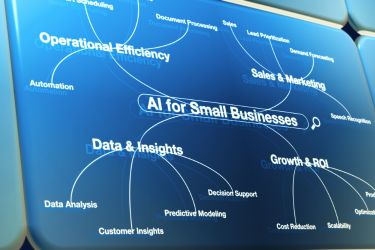
AI tools will do an amazing job for you after you take the time to compile consistent, up-to-date data. If your data is incomplete or difficult to use right now, AI will not be able to make sense of it. Take the time to standardize input, remove duplicate records that could affect predictions, and fill in missing fields, so the technology has all the information it needs to operate effectively.
Granted, it will take you or your team some time at the onset. As a result, you may not see your return on investment as early as you had hoped. However, remember that AI improves as it learns patterns, and spending time at the beginning to ensure data is accurate and actionable makes a significant difference later during operations.
You know your business and can identify pain points. Our team knows AI and its integration in SMB operations. For example, online reputation management is integral to building your brand, including monitoring and responding to reviews. Are curious to see how the technology will impact your unique company? Online reputation management is just one example of what AI integration can do when you are ready to become or stay competitive. Let's look at the bigger picture. Contact us today to schedule a consultation for AI implementation!
-----------------------
AI for SMB Operations: A 3-Part Series
👉 Part 1: Getting Started with AI for Small Businesses








.avif)