.png)
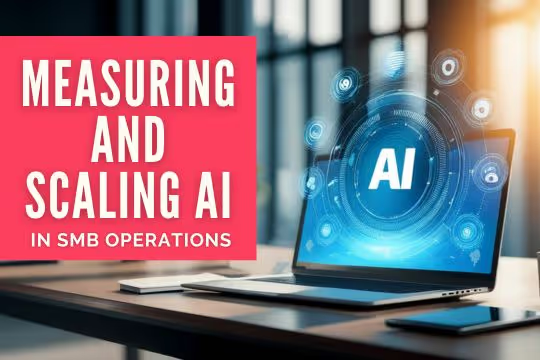
This is the final article in our 3-part series on AI for small business operations. In Part 1, we explored how to get started with AI. In Part 2, we covered practical AI applications in daily operations. Now in Part 3, we’ll focus on measuring AI success, tracking KPIs, and scaling AI solutions responsibly across your business for long-term growth.

Bringing artificial intelligence (AI) into small and mid-sized business (SMB) operations is almost a necessity to become and remain competitive. We have already outlined several tools for introducing AI to workflows. Let's take a look at scaling AI in small businesses. How do you know it is working, and how can you get it from a test phase to a company-wide implementation?
Measuring the efficacy of AI and newly automated workflows answers whether the technology investment is worth the expense. Metrics vary, but typically focus on the success of AI infrastructure in:
Of course, remember that you need to give the AI implementation time to work. Do not expect dramatic changes within the first couple of weeks. Instead, check key performance indicators (KPIs) at one, three, and six months to gauge success.
Measurable results make it clear that it is time to expand AI use beyond a single workflow, department, or pilot trial. When scaling AI in small businesses, owners and managers must do so within the context of digital marketing budget planning. After all, the cost of scaling AI technology must fit within budgetary constraints.
Scaling can follow four simple steps.

Unfortunately, scaling business technology rarely follows the four steps we already mentioned. Instead, you are likely to face challenges specific to SMB operations that you need to address before you can take the next step. Let's talk about some challenges you may face when scaling AI in small businesses.
AI's output is only as good and reliable as the data you input. Generally, AI will receive the necessary data from structured sources such as spreadsheets and databases, unstructured sources such as voicemails and chatbot questions, and streaming data, including real-time logs. That said, you will have problems when data is spread across spreadsheets, emails, outdated records, incomplete databases, and nonstandardized data entry practices. Overcome these challenges by cleaning data. In other words, remove duplicate data, correct errors, fill in missing values, and standardize input.
AI integration strategies fail when the software's tools do not work with your current CRM, accounting, billing, or scheduling programs. Typically, when this occurs in programs, you look for manual workarounds. However, when you go this route, you likely lose any efficiency gains. What you end up with are several unconnected tools that may duplicate some tasks. Fixing this problem may require revisiting the AI tool selection process and replacing programs that do not integrate with your already operational software.
Your datasets evolve, and some may eventually become obsolete. Unless you archive outdated datasets and provide AI with refreshed data, you may notice that the technology will continue to operate with (now) outmoded data. In other cases, your SMB operation may rely on legacy accounting software, on-premises databases, custom software not designed for AI integration, and Excel-based tracking. You can upgrade legacy systems to enable AI integration. For example:

It is tempting to replace everything at once. However, successful AI scalable architecture integration relies on the gradual adoption of effective data processes. Additionally, remember that the cloud plays a critical role in your workflow automation. Once you have well-designed, valuable datasets, it is time to focus on scalable cloud storage. Along with the cloud, security concerns will emerge. It is now apparent that you need to develop policies for responsible AI use, ensure legal and regulatory compliance, and outline data privacy steps for cloud computing.
Technical debt is an elephant in the room that can stand in the way of realizing any return on investment (ROI) of AI integration and scaling. Examples include:
It becomes clear that technical debt is the hidden cost you keep paying for refusing to upgrade your technology. In the past, you may have chosen the cheapest software rather than a scalable alternative. You may have rushed a solution because there was an immediate need to address. When it becomes clear that your technical setup is no longer working, you add new tools but fail to remove the old ones. In short, if the system is going to break under the weight of volume increases, it is time to shed your technical debt.
Whenever you make changes to your business, they need to have a positive impact on your operations, which you can measure in terms of revenue or growth. At the onset of AI implementation, find the pain point you want AI to solve. Examples include reductions in labor hours, increases in sales conversions, or improvements in customer response time. Next, establish a pre-AI baseline. How many hours does your staff spend on specific tasks? What is the cost per lead? What is your average response time to customer questions, orders, and requests?
Once you have established the workflows you want to target for AI integration and the cost of doing business you currently experience, you are in a good position to track AI performance at scale. In other words, measure the same metrics after AI was integrated into the targeted workflows. When you grow the use of AI, repeat the measurements. This is typically the time after taking AI beyond one department and introducing it to the others. Or it may refer to the use of chatbots on social media and your website.
Chart the benefits. Examples include labor cost savings, increased revenue, and the ability to do the work needed to grow the business without hiring additional staff. Next, divide the benefit calculations by the costs. Here, you might look at the cost of the AI tier, the money you spent on setting up the technology, and the ongoing maintenance you will have to do.
It is essential to recognize that SMB operations may need to focus on time-based ROI rather than immediate payback. Your calculations should focus on the number of weeks, months, or years it will take until you break even. Productive KPIs include slower cost growth relative to benefits or a measurable increase in productivity per employee.

You measure the ROI of AI scaling to prove that expanding AI use helps your business grow at a cost that is below revenue. However, ROI is not a stagnant number. In other words, once you arrive at a good figure, it does not mean that you are done. Because human activity is involved in your business, there is a chance that data quality slips, staff members decide not to rely on AI any longer, or the cost of the AI solution you have invested in goes up.
Until you see a change in ROI, you may not have been aware of these changes.
Let's sum up how to grow your business through AI integration.
Additionally, focus on digital marketing as a way for strategic growth and technology planning. We can help you with this aspect. Simply schedule a call today!
-----------------------
AI for SMB Operations: A 3-Part Series
👉 Part 1: Getting Started with AI for Small Businesses
👉 Part 2: Practical AI Applications for SMB Operations
✅ Part 3: Measuring and Scaling AI in SMB Operations








.avif)