.png)
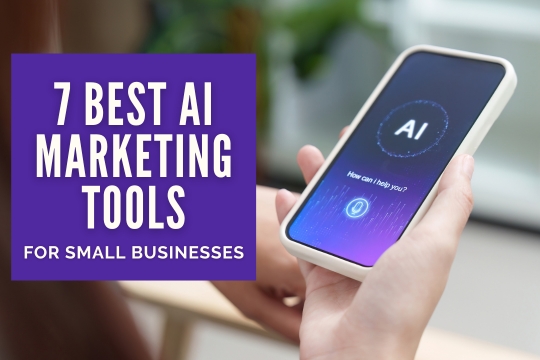
Artificial intelligence (AI) is permeating all areas of commerce. The latest niche to take a closer look at AI is the small business sector. Owners, operators, and managers find that AI is excellent for customer support automation, data analysis, and administrative automation. Another use involves social media captioning, email drafting, and advertising support for e-commerce. How can small businesses use AI for marketing? Does it level the playing field with larger competitors? Do you have to take a course or have coding experience before you can use it? Let's take a closer look.
Small business owners have to keep a close eye on the budget. The budget is tied directly to your staffing decisions, price points, and advertising spending. Another consideration is time. There never seems to be enough of it for a small business. In many cases, AI can be a budget-friendly time-saver that takes on repetitive tasks and frees you up to do something else. Examples of the tasks that can be taken on include writing emails, scheduling appointments, generating invoices, and marketing. This last option could be particularly important for your company, as you compete with larger businesses in your niche.
The three most obvious marketing solutions AI can take on are:
Chatbots are not only time savers but also examples of how to up your customer service game. Who has not landed on a web page that featured a chatbot offering to engage you in conversation? Besides that, they can be instrumental in capturing leads. In simplest terms, a chatbot communicates with your customers via a chat or messaging function on your website, social media profile, or mobile app. In this context, AI is suitable for answering customer inquiries about business hours, pricing, service areas, and product availability.
One of the best-known platforms is the HubSpot chatbot builder, which allows you to integrate its functionality with customer relationship management (CRM) software and similar marketing tools. For Instagram or Facebook, there is ManyChat. Program the chatbot to:

How can small businesses use AI for marketing in addition to basic functions? The chatbot is a good entry point for lead acquisition. But where AI truly shines is in email lead generation. Here, the technology can collect shopper information from website forms, newsletter signups, and quote requests. It stores the information on platforms such as MailChimp.
You can now set up the system to automatically send out a variety of targeted emails that you have already written. Specify the occasion trigger and timing. It is a good idea to vary the content to keep messages fresh and interesting. For example, content could include an introduction to your business, useful information about using your services or products, challenges and solutions customers report, and offers that allow for a direct sales pitch.
Here, AI can:
Not all uses for AI are customer-facing. Some AI marketing tools are necessary for back-office support. For example, in predictive analytics, you can use AI and machine learning to identify and predict patterns. The data used will consist of past sales, customer behavior, and overall marketing performance.
Consider scaling AI in small business operations also to include sales forecasting, inventory planning, and marketing optimization. Other AI marketing automation examples include smart social media scheduling for posts and advertising optimization. AI can become your go-to for defining target audiences, setting budgets, and sending out special offers.
Small and mid-sized businesses (SMBs) greatly benefit from machine learning. As you continue to use the AI platform of your choice, it analyzes business data and identifies patterns. This way, it can determine sales trends, customer buying behavior, and marketing performance. Over time, the platform becomes more attuned to the processes, which, in turn, results in greater accuracy. As the end user, your business benefits greatly from the information that machine learning gleans.
There are several practical uses for growing machine learning that even an SMB just starting out will find useful.
It is interesting to note that this level of machine learning is also suitable for back-office tasks and even for manufacturing processes. Machine learning can detect fraud when presented with unusual patterns in payment processing or e-commerce. It can alert you after it flags the questionable transactions. If your company operates machinery to fabricate products, machine learning AI can track equipment usage and performance data, and assist with scheduling maintenance downtime. In this way, you can act proactively when maintaining your machines and avoid sudden (and expensive) breakdowns.

AI can be instrumental in creating original content. Already, "Walk My Way" by AI-generated artist Breaking Rust reached the number one spot on the Billboard Country Digital Song Sales chart in late 2025. Hollywood is worried that AI will make highly paid actors unnecessary, greatly reducing movie budgets and opening the door to greater revenues.
However, there are some downsides to generative AI for any content you might consider creating.
On the other hand, when used correctly, generative AI will revolutionize the production of marketing materials and greatly reduce the costs you would incur when working with a large marketing team or an advertising firm. AI social media scheduling put on autopilot keeps your profiles active and consistent. It can generate social media captions that are neither spammy nor generic. For social media, you can even create graphics for your marketing campaign.

How can small businesses use AI for all their marketing and implement this AI without technical skills? One reason smaller businesses, in particular, tend to shy away from AI is the fear of having to learn new technology. There used to be some truth to that statement. In the past, new programs had distinct learning curves that were sufficiently significant to warrant college courses.
None of this applies to AI. The easiest way to start with AI is to set clear goals for its usage. What do you want the technology to do? Pick one area. Let's say you want to personalize marketing messages for different segments of your customer base. With this goal in mind, you choose the no-code AI tools that will perform this task. MailChimp and ActiveCampaign are excellent options for email automation. The platforms guide you through the setup, which is typically intuitive and requires no coding.
Most platforms offer pre-built email templates. As you become more comfortable with AI, you can create your own template for specific emails. Until then, the templates are excellent and typically customizable, allowing you to feature your logo, company name, and corporate colors.
To make the most out of the AI, you should review any AI content before it is published. If you have ever received a marketing message that featured "insert name here" and similar notations, you know that this email slipped past someone who published it without checking. Additionally, start small. Choose one customer group segment for AI to interact with. Once you are satisfied with the performance and results, scale the process and add more.
We have mentioned several low-cost AI tools for marketing and discussed practical ways to use them. Let's talk about the difference the use of this technology in your business can make in as little as a year. From where you are now, AI can:
Even if you have not yet embraced the use of social media to its fullest extent, you will find that being competitive means having to do so. But even there, you do not have to go it alone. AI-driven insights for reputation management let you monitor what customers are saying and manage how they interact with the brand. Let's talk about it. Call us today!








.avif)