.png)
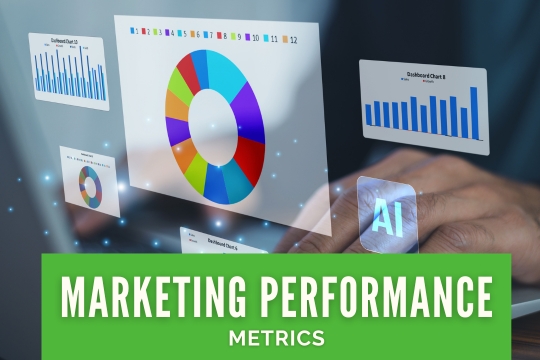
One of the most common questions business owners have about marketing is, "Where do I start?" With so many channels and constant online competition, measuring success can feel like a shot in the dark. If you've ever found yourself overwhelmed by all the statistics and abbreviations on a marketing dashboard, you're not alone. The good news is that you don't need to track every single detail about your marketing to run an effective business.
In fact, you only need these five core marketing metrics to get an effective read on whether your marketing efforts are driving business or costing you valuable dollars on ineffective strategies. The best part? Each metric is easy to track and reveals key details about your business's health, so you can correct course and fine-tune marketing efforts quickly to get the best results.

If you're new to online promotions and wondering what marketing metrics small businesses should track, impressions and reach are a good starting point. Think of them as two sides of the same coin.
Impressions reveal the total number of times your content was displayed in people's feeds, not the number of individual viewers. So your impressions can include multiple instances of the same person seeing your posts or ads.
Reach, on the other hand, is the total number of users who see your content. At first glance, you may think, "Why would I bother checking impressions if reach really shows me how many people are seeing my content?"
The answer is that impressions are important for building brand awareness and increasing the chance of engagement. The more people are exposed to your business's name and content, the more likely they are to interact with it.
Reach, however, indicates a broader audience for your web content and performance; ads that attain higher reach cast a wider net, and organic reach means that algorithms are exposing your content to more people.
In both cases, impressions and reach give you a glimpse of how attractive your digital marketing efforts are to others. Low reach but deep impressions can signal good niche targeting, but it needs to be measured against conversions and engagement to determine whether it's actually performing.
High reach with low impressions, on the other hand, indicates that your brand is being seen by more people, but they're only seeing it once or twice; this is common in brand awareness campaigns and large-scale advertising strategies, where your goal is to get as many people as possible to see your name and product.
How do you decide what to target? When it comes to reach vs. impressions, focus on your ultimate goals. Do you want to expand your audience or focus on convincing a smaller number of people to take action?
Expert Tip: Don't stop at reach and impressions. They're top-level metrics that give you an idea of where and how your content is performing at the surface level. To leverage them, you need to pair them with engagement metrics, like shares and comments, or conversions, to see whether your visibility is positively impacting your sales.
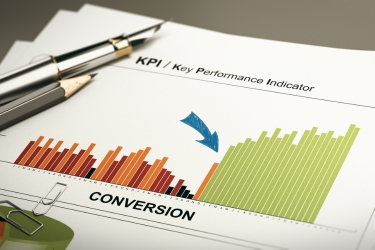
Conversion rate (CVR) is a vital metric to track as part of your sales process management. A high clickthrough rate (CTR) is often seen as a hallmark of digital success, but it can lead to a false positive in your marketing ROI. While a high CTR signals good search engine or ad optimization, you don't know whether your web pages or paid media are really doing their job if you don't track conversions.
The conversion rate tells you how many people took a desired action after interacting with your business. This could be downloading something, entering their email to join a newsletter, clicking a button to call your office or making a direct purchase. The list goes on, but what matters is that you carefully assess whether your content is contributing to the bottom line or simply attracting attention with no substance.
A low CTR ultimately means your content isn't motivating people to choose your business. The beauty of CTR is that it's easy to track at different levels of the marketing funnel and sales pipeline; whether you're trying to generate more leads or encourage repeat business, it's a valuable metric that cuts straight to the chase.
Expert Tip: Make sure you tailor your CVR to each campaign and marketing segment; track a different conversion for first-time website visitors and another for pre-purchase, qualified leads across various platforms, like email and SMS. Tracking CTR performance will help you measure which incentives and techniques are most effective with audiences across different channels.
Your customer acquisition cost reveals how much you spend on marketing to get one new customer. The math is simple: a low CAC means a higher profit for your business. A good CAC in marketing is considered to be at least 3:1, meaning you earn three times what you spend marketing to someone.
The exact figures vary greatly by business, because a "small" marketing budget for a national corporation is not the same as a small budget for a local business with 2 employees.
The figures themselves, however, aren't the most important detail. What matters is that you're actively tracking how much money you make vs. how much you spend, and how much your marketing investment pays you back.
When it comes to what marketing metrics small businesses should track, CAC should be at the top of the list, but it's often one of the most overlooked. Don't be fooled by "vanity metrics" like likes, views, and follower counts. These don't matter as much as many people believe; to assess the depth and power of any good marketing strategy, you need to connect it to actual profits, and CAC will clearly reveal whether you're overspending on advertising.
Similar to CAC, CLV shows how much revenue you earn from a customer over the entire course of their relationship with your company. In some businesses, this may be a one-time purchase; in others, it could be years of repeat sales.
The real strength lies in evaluating your customer lifetime value against your customer acquisition cost (CLV: CAC). The ideal target is a CAC that's no more than 33% of your CLV; your aim is always to earn more from a customer than you pay to acquire them.
If tracking these metrics seems difficult, consider sales process management software that makes it easy to monitor lead generation and customer journeys from the first point of contact through close.
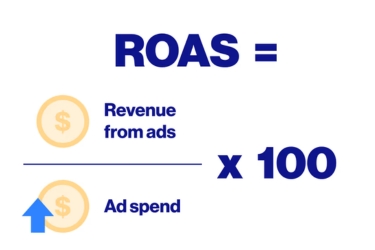
The best way to directly measure your ad budget against sales is to track return on ad spend (ROAS). If return on investment (ROI) looks at your marketing budget as a whole, ROAS is a more specific metric that reveals how much money your ads generate for your business.
ROAS measures campaign-level budget, whereas CAC is a broader measurement of your marketing and sales success. When you're marketing your small business online, ROAS is a key metric that helps you avoid paying more than you have to for better reach or sales.
Expert Tip: Focus on targeting high-intent leads rather than a generalized audience; while you may think a bigger reach and higher ad spend mean a higher chance of sales, that isn't entirely true. If you want to maximize your ad spend, have a deep understanding of your audience: what messaging resonates with them and which ads will prompt them to take action. Then make sure your sales process is seamless and satisfying so you can close the deal ASAP.
While marketing is a set of skills that takes time to develop, you can still find success with a small budget as a beginner. These are the tips you should keep in mind to manage costs, maximize efficiency, and measure results:
Contrary to popular belief, marketing isn't a mystifying field reserved for experts. Business owners from all industries and backgrounds can find success with the right tools and some research.
Once you know what marketing metrics small businesses should track, you're better equipped to evaluate different tools and find software that genuinely benefits your bottom line.
If you're interested in lead tracking software, explore our options to start growing your business strategically.








.avif)